Wednesday, 16 May 2012

The Israeli-Palestinian conflict: Getting to the root of the problem...

Today, I signed a petition. Unsurprising perhaps, given the amount of mailing lists I am on regarding human rights, poverty alleviation, climate change and other global issues. Having read the summary I decided it was a worthy cause and so happily added my name to the thousands of others. The petition was against the Israeli government who are apparently uprooting olive trees owned by Palestinian farmers (http://www.change.org/petitions/stop-uprooting-palestinian-trees). This to me seems immediately unfair and unnecessary; farmers in developing countries are often the victim of inconsiderate behaviour by governments or large corporations. Reports of land grabs in Africa and humble farmers being made destitute by intensive industry which hijacks their land are unquestionably tragic and morally wrong. With this in mind, I signed the petition as an act of solidarity with those who also respect peoples right to make a living and right to self determination.


Given that next year I will be studying the Arab world for the first time, I figured this may be a good starting point, a "way in" to the overwhelming topic of war and peace in the Middle East. But, having looked at just two hits from my google search of "understanding Israeli-Palestinian conflict" I am already feeling fuzzy-headed. Unfortunately it is assumed that you already know about the previous century of religious tension and development, let alone the recent developments riddled with political clashes, secular violence and foreign involvement.

So, as I have been some what neglecting this blog recently, I will use it to document my quest to gain a basic understanding of this vital issue. In the late 1800's and early 1900's the Jewish and Arab populations of the Middle East underwent a nationalist movement. The Jews Zionist movement highlighted their support of a Jewish nation-state called the Land of Israel where they would be free from anti-Semitic discrimination and not integrate with other religions (although such a movement has been part of the Jewish religion for millenia, it was only officially established in 1897 as a response to persecution). Meanwhile, Palestinian nationalism is not so easily defined. With different groups aligning themselves with different villages, regions and religions and some aligning themselves against colonialism or rule by other states - known as Pan-Arabism (“Palestine was conquered in times past by ancient Egyptians, Hittites, Philistines, Israel, Assyrians, Babylonians, Persians, Romans, Muslim Arabs, Mamlukes, Ottomans, the British, the Zionists…the population remained constant-and is now still Palestinian.”). Regardless of specific beliefs, there was a distinct emphasis on self-government by Palestinian people. These similar yet conflicting movements collided in the Levant (the region shown below).
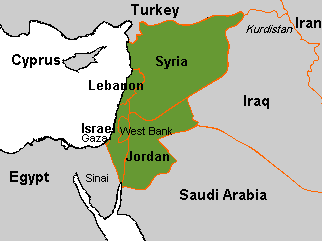


At the end of the 1800's, the majority of inhabitants of Palestine were Arab Muslims whilst the majority of Jews lived in Europe or the Mediterranean.  However, as the Jews began to descend on, what they see as their historic homeland, tension mounted. In the late 19th century small acts of violence and retaliation took place in communities between the Jews and the Arabs. For example,

Another incident happened in Petach Tikva, where in early 1886 the Jewish settlers demanded that their tenants vacate the disputed land and started encroaching on it. On March 28, a Jewish settler crossing this land was attacked and robbed of his horse by Yahudiya Arabs, while the settlers confiscated nine mules found grazing in their fields, though it is not clear which incident came first and which was the retaliation. The Jewish settlers refused to return the mules, a decision viewed as a provocation. The following day, when most of the settlement's men folk were away, fifty or sixty Arab villagers attacked Petach Tikva, vandalising houses and fields and carrying off much of the livestock.

At first the objection to immigrants was on cultural, not religious grounds (as most Jews were from Russia and Europe). However, as waves of Jewish settlers flooded the region their Zionist aspirations became apparent. Consequently, the Arab population began protesting against the acquisition of lands by the Jewish population. Thus, in 1892 the Ottoman authorities (under which Palestine was ruled) banned land sales to foreigners. Still, by 1914 the Jewish population in Palestine had risen to over 60,000 and with WW1 on the horizon, things were not about to improve.


Monday, 27 February 2012

The Jolly Pilgrim

Setting out from his London home, Peter Baker seems like a fairly standard guy; he has a job, a home, a family and friends. But he also has an idea. His idea is get on a bicycle and ride to Istanbul and to document his travels through numerous diary entries and, as he calls them, “Global Musings” in which he reflects on the state of planet earth and its inhabitants. What follows is a thoroughly engaging and thought-provoking story of, quite literally, a jolly pilgrim making his jolly way around some of the most fascinating places in the world.
As he cycles across Europe he describes the people he meets in what strikes me as a remarkably honest and highly perceptive way; not judging, but interpreting people is what gives the book its human aspect and prevents is from being just another travel log. Baker experiences dizzying highs and crushing lows (for example when, after rendezvousing with the girl he wants to marry, it transpires it is not meant to be) but relentlessly journeys on across the globe visiting five continents and 24 countries and fully embracing the vibrancy and unique delights of each place. With only a rough plan, the freedom to be spontaneous is enviable and opens up a wealth of unforeseen opportunities such as working in a drag club, dancing salsa in an Ecuadorian prison and climbing landmarks in the dead of night. Whilst not all experiences are positive – cue bag thefts, heartache, financial crises and hospitalisation – they are savoured as a vital part of what it means to be human.
The backdrop for this insight into the human condition is a mirage of vivacious cities, picturesque retreats and exotic paradises. Each place is described vividly and with more than enough information for the reader to understand what makes it so special. Intellectually stimulating yet not purely factual, the descriptions convey a genuine interest for the history, politics and geography of a place. Amongst visiting some amazing sights, pondering the great religions of the world and generally questioning the meaning of life, Baker finds to do some serious partying with the people he befriends. The combination of vodka, sex, drugs and dancing makes for a wild experience of impulse and rapture.
There are two major themes which spoke to me in the book. Firstly, the importance of kinship, from the most raw and intimate connections to the most basic and simplistic act of kindness to a wandering traveller; the foundations of humanity lies in social interaction and are as precious as the air we breathe. The duty people have to explore and understand the world we live in, to question it, to get out there an experience it. The Jolly Pilgrim leads by example, grabs every opportunity with both hands and truly lives each moment.  A truly inspiring book.


Monday, 30 January 2012

“Human Safaris” exposed


The human zoos of colonial times are now quite rightly seen as a barbaric and cruel exploitation of indigenous peoples. And yet, every year hundreds if not thousands of tourists illegally pass through protected national parks and nature reserves in order to glimpse tribal communities in their natural land. The latest tribe to be involved in the controversy is the Jarawa tribe of the Andaman Islands in India. With a population of just 200-300 people they are already under threat from poachers who occupy their land and steal their means of survival. This tribe, and many like it, have chosen to resist interaction with the outside world although they have already had a severe decline in population numbers due to outbreaks of Western diseases such as measles.

Recently the British newspaper, The Observer, along with other charities and NGO’s dedicated to protecting the lives of indigenous people uncovered evidence of local authorities being bribed to turn a blind eye to such excursions. Videos have been revealed of policemen ordering Jarawa women to dance in order to entertain the tourists who eagerly snap photos of the tribes’ exotic attire. Furthermore, an audio recording of an under-cover journalist discussing bribes with a tour provider has caused outrage as it exposes not only the corruption of the authorities but also the discrimination against the native tribe as the journalist is told tips and tricks to tempt the people out of their safe environment with biscuits and sweets.

In the vast majority of cases, these trips are the result of an innocent curiosity about the tribes’ way of life shown by many tourists. However, tour operators are exploiting this interest for monetary gains and care little for the welfare of the people themselves. The roads built to accommodate such trips are damaging to the wildlife and environment surrounding the Jarawa and providing their means for subsistence. NGO’s both in India and abroad are working to encourage the Indian government to do more to help as well as raising awareness amongst tourists about the negative effects of the industry.

A world without Wiki?

Can you imagine a world without every student’s favourite reference site, Wikipedia? On the 18th of January such a world became a reality as the largest online encyclopaedia, which has taken over a decade to build, blacked out its website for a day in protest of legislation proposed by US Congress which might put the future of websites such as Wikipedia, Facebook and Google at serious risk. The bill, if passed, would enable officials to prevent access to websites which contain pirated material. Wikipedia have commented saying that the The Stop Online Piracy Act (SOPA) and PROTECT IP Act (PIPA) “will severely inhibit people's access to online information. This is not a problem that will solely affect people in the United States: it will affect everyone around the world”, and therefore they are hoping to encourage users to share their views with through social media and other mediums. Despite many websites being monitored for copyright infringements, it is possible that some of the millions of pages published every day go undetected. However, if this is detected by officials, the entire site will be shut down, not just the specific page. The bill even extends to cover links to pages which are associated with piracy. There are many signs that protests like these are working; last weekend, Senator Cardin, who cosponsored the legislation, announced he will vote against it along with President Obama. The cause has now reached a tipping point, but with Wikipedia leading the protest, the issue has been thrust into the public interest and the reaction has been overwhelming.


Thursday, 17 November 2011

America calls on UK to advocate cluster bombs

When a cluster bomb explodes the damage is wide-ranging and ruthless. Expelling several “bomblets” upon contact can cause serious damage to the target be it infrastructure, building or human. In addition, many bombs do not explode on contact; they lie dormant and continue to pose a silent, but deadly threat to civilians long after the conflict has ended. It is because of this threat to non-combatants that public pressure demanded a ban on these cruel bombs. Now, three years after the Convention on Cluster Munitions was adopted, 108 states have signed the agreement.

What sounds like a triumph by over half the world’s governments is now being undermined by attempts to pass a new international law which permits the use of such inhumane and callous weapons. The pressure for this law comes just before the conference for the Convention on Conventional Weapons in Geneva during which delegates will decide their position on the law. The pressure for such a change is coming from America, China and Russia who are the main exporters of such weapons. The “watered-down” version of the law, proposed by Washington, would see the re-emergence of cluster bombs in times of conflict, resulting in continued endangerment of the innocent people who live nearby – all in the name of better trade and bigger profits.

Countries such as Mexico, Norway and Austria are making a stand against this reckless decision. It remains to be seen whether countries such as France, Germany and the UK will allow themselves to be bullied into going against the views of the public and the basic humanitarian values considered so fundamental to our society. The call for compromise on a weapon designed to cause maximum harm and offers no suggestion of restraint during times of conflict is absurd. The indiscriminate nature of cluster bombs which is responsible for inflicting a cruel death to many and a slow suffering to many more was one of the main reasons why 22 out of 28 NATO allies signed up to the agreement to ban their use, now they must ask themselves – what’s changed?

Friday, 21 October 2011

Day Five - Nearly there..

My morning starts as normal, a big bowl of porridge with honey and banana to see me through the morning's lectures... but whilst wolfing it down and packing my bag at the same time I find a moment to consider my choice of honey.. A little while ago I was shopping and stumbled across an ethical dilemma in the form of my favourite porridge accompaniment; To buy local, organic honey... or to buy Fairtrade honey from Africa? Is it better to support local farmers and "eat local" or to ensure farmers in developing worlds have a fair price for their produce? After a good ten minutes standing in the condiments aisle, I reached a conclusion - I chose local. And I'll tell you why... Local food means less greed from the West for goods from other countries (which we can amply supply ourselves), less food miles and, therefore less contribution to climate change. Food miles, for all you non-climate-change-geeks refer to the distance your food has travelled to get to you. Another prime example from my day was my Golden Delicious apple straight from Somerset down the road... NOT from America. The mind boggles that so many of the foods we can grow in Britain are being bought from far off places and thus the transport required to bring them to your "local" supermarket is having a huge effect on the planet. I also snapped this photo of some blueberries in Sainsbury's today... Enough said.

How does this effect food shortages? As temperatures rise, crop yields will fall – possibly to half of their current levels in some African countries. At the same time, extreme weather events like heat waves, droughts and floods will get worse and happen more often, and the seasons that people rely on to grow crops will get even more unpredictable. The world’s governments have dragged their feet for too long. It's time to stop listening to industrial lobbies – and start dealing with a situation that’s only going to get more urgent.


Later on I have some stirfry vegetables bought from the local grocers (which is hugely better value than any supermarket in town!) and I've got to say, I'm feeling all the more healthier for it!

Day Four - Still Alive

Another successful day and I've got to admit, this isn't as hard as expected. Granted, I miss being able to steal a spoonful of my friend's dinner without having to ask for a list of ingredients. And actually I would have loved a slither of cheese on my bread to liven up the meal.... But in general, I still look forward to my meals and have less to worry about in terms of sell-by dates and funny smelling chicken... Today's menu was some bran flakes and soy milk for breakfast, some soup for lunch and after a long day I return home for some ratatouille for dinner... deliscious! Home here is used tentatively as I actually mean my uni halls, but regardless of its box-like quality I feel I have made it homely enough to be called home at least for now. Another of Oxfam's initiatives is to ensure farmers everywhere are protected from having their home stolen fromt them.

Since the food price spikes of 2008, wealthy companies have invested heavily in cheap agricultural land in poor countries, often for commercial use. But in many cases, the land sold is actually being used by poor families to grow food. These families are often forcibly evicted with little or no warning or compensation, and in many cases the land is either left idle by investors who know it will only grow in value, or used in ways that reduce food production. So it's time for effective global rules to get land grabs under control – rules which ensure local communities see the benefits of investments and which help make sure that governments provide secure access to land for smallholder farmers, and especially women.